Wednesday, May 29, 2013

The most basic things you may have not known about Tanzania festivals. (Part 1)

| |
0 comments
My first ever festival was my birth day, and am glad to say that today is my birth day. It is commonly known that when a child is born comes the celebration. Well I like festivals and I hope you do too. I won’t talk about my birth day but about Tanzania annul festivals in depth and in details.

Many writers don’t have good details on Tanzania festivals like the way I do, (am bragging about it!). I have read most articles on festivals that talk about public holidays mostly. But they don’t know how these holidays are brought into life by Tanzanians; they simply assume the similarities with other countries.

Take an example of Christmas.  I know it’s only May and we have long way to go for Christmas, but just read this to prepare yourself for the holiday. First of all it doesn’t snow here in Tanzania so please don’t compare it with the U.S. or any other country.  If you want the snowing you ought to hike Mount Kilimanjaro. But one thing in common is the family gathering tradition. I am Chagga ( a tribe from Kilimanjaro region) by native and it’s a tradition to go back home in Kilimanjaro for this holiday. At this time of the year most things becomes untouchable like an Indian dalit though the reason behind is the price tag, but people will still buy. I guess Nakumat Super Market had this in mind that’s why they have a branch in Moshi Town. The buzz, feasting and the fun are the most quality things you can’t ignore during Christmas in Tanzania.

Chagga women in cleaning after feasting.

Ramadan and the Eid-al-fitr is a Muslim prolonged festival like no other. The one thing I like the most about this ceremony is the fasting and the reward of iftar in swahili FUTARI (a meal especially prepared after the long 12 hours fasting) after the fast. If you can be as lucky as me you get invited to have a futari. Who can deny the taste of heavy juicy coconut milk, spices and everything nice as compliments to healthy ingredients in the making of futari? I bet, you won’t want to miss the next invitation. The setting and arrangements of the futari is done on a well knitted mart, could be locally made or bought from somewhere else. Next thing is folding your legs and share the delicious futari. Another thing noticeable is the full use of khangas (original made In Tanzania piece of cloth) and hijabu(Muslim way of dressing) very conservative. Other Muslim festivals include Eid-al-hajj (festival of sacrifice) Islamic New year and Prophet Mohammad's birth day. Most of times it's published that during Ramadan it is consider offensives eating in public but I'm real not sure about that, since Christians are all over. This applies effectively in Zanzibar.  

Political public holidays like Union day and Independent day have their own tastes and are very appealing. Despite the commemoration of these important days we get to enjoy Gwaride (parade) from different security and defense forces divisions like the Police and the Army. Here you enjoy the quality performance from the parading activities like marching. Most of these holidays are conducted at the national stadium most of times in Dar es salaam. I like traditional dances that are performed on these days and the reminder of the national song and anthem.
Political holidays in calender:
12 Jan: Zanzibar Revolution Day (Zanzibar)
26 Apr: Union Day
9 Dec: Independence Day

Stay tuned for part two. Stories to be covered includes the most popular and well know festivals by international tourist in Tanzania which most of them happen in Zanzibar. And the reasons behind their popularity.
Read More

Sunday, May 19, 2013

Get rewarded by finding the most elusive pygmy hippos in Mafia Island.

| |
0 comments

"Waswahili walisema lisemwalo lipo kama halipo laja" Swahili said, what is said exists and if it doesn't it is coming. I hope that is clear with you.

Rumor has it that there are world famous pygmy hippos in mafia Island. I don't know exactly how I should frame this but the rumor has two facets. To some it's a mere lie but to others its so real and true like heart beatings. When a monster web source declare something most of us believe it all. Wikipedia reported that the existence pygmy hippos is just an illusion because there are no confirmed sighting.

My long time online friend who runs Ras Mbisi lodge in Mafia Island, Michelle Vickers recently published a post and got my attention. Here is what she had to say and wrote on her blog.

"Ever since we first arrived on Mafia, we have been looking for the elusive rumored Hippos that are reputed to live around the lakes at Chungaruma close to Ras Mbisi. We've seen droppings, we've had staff tell us they'd seen them that morning, I've seen the skeletons at the Fisheries Office in Kilindoni. Never seen one. However 2 guests that stayed in January this year did, and today they sent me a photo, here it is. They do exist :)"

In the red ring is a pygmy hippo in Mafia Island as seen this January. Photo courtesy of Ras Mbisi guests.

Ras Mbisi story made me dig dipper about the elusive hippos, as nick named. I went further by going through other informative sites to learn the entire mystery of their existence. Here are some other interesting stories in highlight.

CHANGES FOR THE MAFIA ISLAND HIPPOPOTAMUS ECO-TOURISM PROJECT
Over the next few months the Tanzania Marine programme wants to initiate a conservation and ecotourism project for the Hippopotamus (Hippopotamus amphibious). The island of Mafia harbours a relatively small population of hipposthese inhabit a network of lagoons found North-West of the island. Being it a nocturnal and semi-aquatic mammal poses numerous challenges when monitoring this species. There is no exact number of the actual population size in this area of Mafia Island, however, the Frontier team has managed to record around 20 to 40 individuals throughout their census. 

The next testimony left my jaw dropped! Super shocked. If the recording is this old what else can I say?  This source is from Mafia Island Blog.

.......Here live a number of small hippos which may have crossed from the mainland or were washed to the island by floods of the Rufiji River system. They have been on Mafia many years, since Dr Baumann records their presence in 1895.........

The above are some of confirmation I found, but then again I had to confirm it with Tanzania Tourist Board via twitter conversation and this is what they had to say:


Oops! I had to wait for a week for The "board" to confirm, typical Africa! Anyway here you have it:


What makes me go mad with my heart and adrenalin up so high is my curious adventure in mind in search of the hippos. I pray and hope not to be unlucky like these fellows 1 or 7 who really narrowed my chances to take on the adventure. If Naaman had to deep himself into river Jordan seven times to be healed from leprosy. (From the Bible). Perhaps I can get lucky with the hippos if I have to first deep myself into the Oceanic water of Mafia Island. Or maybe voodoo and potion might help!!

This mystery also gave me an idea that may be Tanzania should search for hippos and not eggs on Easter Holidays. How cool could that be?

I argue the Republic United of Tanzania under the Ministry of Natural Resources and tourism or Tanzania Tourist Board, to run a campaign or competition in search of hippos and reward those who would be successful. This might turn out to be an exotic exercise like no other and probably lure more tourists into the Island. “Easter Hippos Search” Isn’t that awesome and promising? It’s our call!

I have come up with my own proverb that goes by “As elusive as pygmy Mafia Island hippos.”
See you in MAFIA ISLAND coming Easter.

Note: Tanzania has lot of world heritage sites, and we have been depending on tourism for foreign exchange. We want to keep on gaining and benefit from these natural resources for today and the future ahead. After saying so I argue you to be a responsible tourist so that we can enjoy the natural wonders by conserving them and passing them on to the next generations. Thank you for your understanding.


Read More

Tuesday, May 7, 2013

Macon Dunnagan, and two others are appointed by Tanzania as the U.S. "Goodwill Ambassadors of Tourism."

| |
0 comments

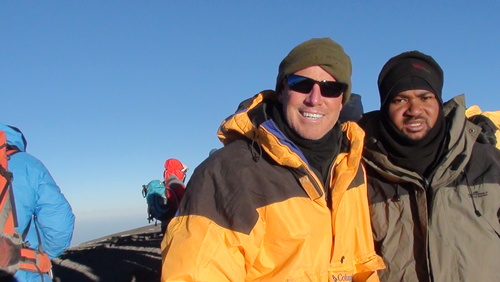
Thank you Hon.Amb. Kagasheki for your appointment of the three Goodwill Ambassadors to promote tourism to Tanzania in the United States. Am impressed with your decision in regard of Macon Dunnagan.  Macon Dunnagan is truly an ambassador at heart, I came to know about him on twitter. He is my follower and am following him back, ever since we got connected have learnt some things that he is doing for Tanzania. Very devoted and enthusiastic on what he loves most, hiking Mount Kilimanjaro. That is why he hold the records. Congratulations to you Macon Dunnagan and the other two, now that you are official I believe the best is yet to come.

Macon Dunnagan on the left doing what he love (Hiking Mount Kilimanjaro).
Tanzania’s Minister of Natural Resources and Tourism, Honorable Ambassador Khamis S.Kagasheki, MP, announced the appointment of three Goodwill Ambassadors to promote tourism to Tanzania in the United States, Patrick Steenberge, President, Global Football; Macon Dunnagan, Kilimanjaro Expedition Director; and  Dr. Philip Imler, Founder and President, Seven Natural Wonders.

Hon.Amb. Kagasheki, in making the announcement, said that “Tourism is the leading earner of Foreign Exchange in Tanzania, and the United States is Tanzania’s most significant tourist generating market. For this reason, we recognize the pivotal role that Goodwill Ambassadors can have on impacting key agenda items of the country through marketing, promotion and facilitation of strategic partnerships in their special areas of influence.”

Each of the three Goodwill Ambassadors has already made a huge impact on Tanzania Tourism. Patrick Steenberge, President of Texas-based Global Football, was the visionary who brought the first ever college American football game played on African soil to Tanzania in May of 2011. The game itself, played between Drake University from Iowa and an all-star team from the CONADEIP conference of schools in Mexico, generated enormous press coverage including ITV Tanzania, ESPN Magazine and a 45-minute documentary broadcast on CBS Sports Network. But the true highlight was the goodwill and friendships that were created when the players and their families and friends who joined them in Tanzania, completed a charity climb of Kilimanjaro and participated in volunteer projects to benefit the local communities. The visiting players and coaches also held American football clinics to introduce more than 500 local youngsters to the sport.  The impact in the sports world and in the communities is on-going for Tanzania and Global Football is planning a second game and philanthropic visit to Tanzania in the near future.

Macon Dunnagan, based in Charlotte, North Carolina is the Kilimanjaro Expedition Director for Zara Tours and has led many charity climbs up Kilimanjaro. He has climbed “the Roof of Africa” 26 times, and by September 2013 will have completed his 30th summit. He is also the current record holder for climbing Kilimanjaro four times in 28 days and has used his position to raise funds for Ovarian Cancer Canada’s "Expedition of Hope" and the Rotary District 7680’s "End Polio Now". In 2001, Dunnagan published his first book Sons of Kilimanjaro and has been a frequent speaker behalf of Tanzania at trade shows throughout the  US.

Dr. Philip Imler, Founder and President, Seven Natural Wonders, was in Tanzania in February to announce Serengeti National Parkas the number one winner for Africa in a worldwide voting campaign for the “Seven Natural Wonders of Africa”. Tanzania’s world famous Mt. Kilimanjaro, the tallest free standing mountain in Africa and the Ngorongoro Crater were also among the top winners for Africa. The contest, and Tanzania being the only country with the most winning nominations, generated enormous prestige and publicity for Tanzania Tourism.

Read More

Monday, April 22, 2013

Top 10 reasons to visit Tanzania.

| |
0 comments
This largest country in Eastern Africa has natural attractions that every rival country envy. After scooping three top accolades at Seven Natural Wonders of Africa what else is to be said about this paradise. From the largest to the smallest national park in Africa both are found in the remoteness of the country. Despite having 15 national park excluding game reserves, you are guarantee to meet massive animals eye -to- eye if you come in season. Dar es salaam makes the country be known Africa's Dubai due to its commercial activities and modernness, still culture is one key element that lure tourists from around the world.

Canoeing
While other African countries suffocates their tourists by congesting them into one or two water bodies. Tanzania offers a vast range more than any other African country. You can choose to canoe or other water related activities in any of these; Lake Victoria, Lake Tanganyika, Lake Nyasa and the Indian Ocean to mention a few. There is room for everyone and a choice to do it around town or in the wilderness. In Momella Lake, the giraffe can be clearly seen from a very close range, giving you a taste of the true nature of Africa. In Lake Manyara and the Momella lakes the Flamingos flock in great number and can be seen on mass from great distances, and Lake Duluti has a particularly wide range of many different beautiful bird species. 


Canoeing at Lake Momella.


Bushcamping
Ranging from uberstylish chalets primed for a Vogue photo shoot to more rustic bamboo and thatch affairs, bushcamps tend to be remotely situated and intimate, with no more than half a dozen rooms. Sitting down to a candlelit dinner of expertly prepared haute cuisine and a couple of drinks is simply awesome.  The evening is spent around the campfire listening to the sound of the African night - the distant roar of Lion and the doleful, whooping, "laugh" of the Hyena nearby is an unforgettable experience.

The Great Wildebeest Migration (Serengeti)
Topping the Seven Natural Wonders of Africa nothing compares to the live watch of the great migrations. The best time to see the migration is usually between June and August when the wildebeest congregate and prepare to cross the Grumeti River. However the route and timing of the migration is unpredictable so visitors must plan carefully to be assured of seeing the spectacle. During the early wet season (December to April) the animals are found on the short grass plains around Lake Ndutu, the Moru Kopjes, the Gol Mountains and Seronera in the south of the park.

A vital Culture and Traditions
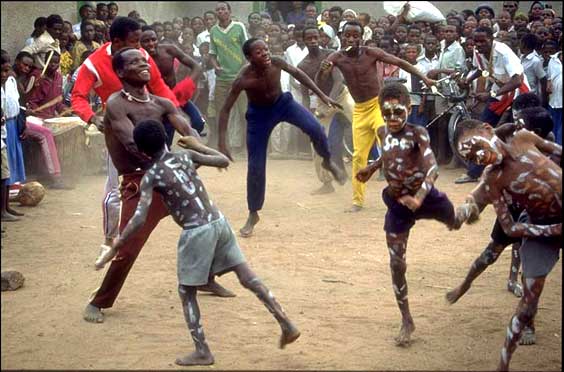
Tanzanian's Social fabric charm is the prime attraction for cultural and eco-tourism. The folklore, the traditional "ngomas" and the dancing styles vary from one tribe to another. When dancing, the Makonde vibrate their bottoms in "Sindimba" frenzy and the "Zaramo" bounce the undulating "Mdundiko" procession. The Maasai in their leaping dance going simultaneously with rhythmic chant of their deep voices which can scare even a he lion! The use of live snakes by the "Sukuma" such as embracing huge pythons and struggling with during the "Bugobogobo" dance turn such occasions into unforgettable scenes to a visitor. Each of the 120 tribes has its ngoma and dancing all of which styles are quite fascinating and sometimes sexy.


A traditional dance in Tanzania.

Festivals
Tanzania's annual events range from traditional festivals that celebrate local culture and arts to sporting competitions combining physical challenges with breathtaking and exotic scenery. Other festivities include those which commemorate political events in Tanzania.
On Zanzibar, many of the celebrations and things to do are of a religious nature, and Muslim holidays are always cause for much merriment. Particularly popular here is Mwaka Kogwa and the Zanzibar International Film Festival (ZIFF), both of which are staged in July, and the musical extravaganza in February that is the Sauti za Busara.


Remains of the colonial.
Being the home of the earliest man the Australopithecines, discovered at  Laetoli near Olduvai Gorge in northern Tanzania, by archaeologist Mary Leakey in 1978. Tanzania is still the home of colonial remains in various spots like the Bagamoyo slave market ruins which is the UNESCO World Heritage, the ancient colonial buildings in the capital city of Dar es salaam to mention a few.

St. Joseph Church in the center of Dar es salaam

 Urban Vibes
Tanzania’s capital of Dar es salaam deserves to be more than simply a pit stop or way station between interior regions – its modernity and cosmopolitan mix of people offer a window to understanding the country as a whole. The city’s young and stylish hit the happening restaurants and clubs, many of which are in and around city center and Arcades Shopping Center or shopping mall. While admittedly overwhelming to the senses, the city’s outdoor markets are worth experiencing to see how ordinary Dar es salaam indigenous  or famously known Wabongo  do their everyday shopping. 

Mountain Kilimanjaro (The Roof of Africa)
Above the gently rolling hills and plateau of northern Tanzania rise the snowy peaks of Mt Kilimanjaro, its slope and glaciers shimmering above the clouds. Kilimanjaro is located near the town of Moshi and is a protected area, carefully regulated for climbers to enjoy without leaving a trace of their presence. The mountain’s ecosystems are as strikingly beautiful as they are varied and diverse. Climbing Mt Kilimanjaro is the highlight of many visitors’ experience in Tanzania. Hiking on the ‘rooftop’ of Africa is the adventure of a life time, and anyone from seasoned trekker to a reasonably fit first-time enthusiast can scale the snowy peak. Despite Mount Kilimanjaro there are other mountains in Tanzania worthy knowing about. 

Walking Safaris
Tanzania offers an adventure to explore the most spectacular wilderness and cultural tour and safari on foot. Having 15 national parks means more intimacy, closer look and feel of Africa's wilderness. A legacy of Tanzania’s pioneering conservationists, ambling through lush grass or dusty sandbanks on the trail of a herd of elephants is a thrilling experience. And even if you don’t see the animals themselves, the guides or rifle-carrying scouts will explain how much is revealed by the animal scat and paw prints. TV detectives have nothing on these guys.

Tourist in close contact with elephants in a walking Safari
Zanzibar
The dazzling archipelago in the Indian Ocean is one of the most popular places to visit in Tanzania. Zanzibar’s sparkling white beaches, crystal clear water, and great variety of things to do make it a must for anyone visiting Tanzania. While there, you can snorkel or scuba dive, go on a spice plantation tour, visit Stone Town, swim with the dolphins, or just lie on the beach and soak up the sun.

Note: Tanzania has lot of world heritage sites, and we have been depending on tourism for foreign exchange. We want to keep on gaining and benefit from these natural resources for today and the future ahead. After saying so I argue to be a responsible tourist so that we can enjoy the natural wonders by conserving them and passing them on to the next generations. Thank you for your understanding.

Read More

Sunday, April 21, 2013

How talent is much needed by Tanzania Tourist Board for Tourism Posters Competition.

| |
0 comments


ANNOUNCEMENT ON TOURISM POSTERS COMPETITION
The United Nation World Tourism Organization (UNWTO) has announced a Tourism posters competition in which every member country including Tanzania is invited to submit one sole poster designed to promote tourism of each particular country in electronic format. A panel of judges who will be appointed by the UNWTO will select 7 best posters that will appear on UNWTO website for two years until the next edition in 2015.

 In this regard, Tanzania Tourist Board (TTB) wishes to invite talented individuals to design posters for the said purpose having an impressive creativity, beauty, and high level of graphic design and communication which will be seen to depict what Tanzania has to offer as a unique tourist destination. Posters should be submitted to TTB in a file no larger than 5 MB by April 30th, 2013 via the following email address: marketing@tanzaniatourism.go.tz. A prize will be given to the best artist whose poster will be chosen as the first winner.

For more information please contact:

The Managing Director,
IPS Building 3rd floor,
Samora Avenue/Azikiwe Street,
P.O. Box 2485 Dar-es-salaam, Tanzania
Tel: 255-22-2111244/5

Read More

Wednesday, April 17, 2013

10 ways to remember and honor legendary Bi. Kidude.

| |
0 comments
Youthful Bi. Kidude

Bi Kidude in the making.

Yalaiti Leo na Kesho peponi. (Today and tomorrow in heaven)

Fatuma Binti Baraka, Bi Kidude
You have come of age and died
But I'll mourn you forever
What a lose of a legendary?

I mourn as I sing,
Mohogo wajamg'ombe
You had a melodious voice
Never will I forget

Zanzibar ooh Zanzibar
The land of your ancestors
Dhows brought in Taarab
You adopted and made it big

Since teenhood to old days
You kept up with music
All shortcoming and circumstances
couldn't ground you down

You are as Thatcher in music
Perhaps why you two are gone
Your were a power house
No doubt you'll be missed

Unyago needs a leader
And you were of such
Who will teach our girls?
Kopa and Bi Chau are crying

Tobacco has lost a market
Youngsters lost a featuring
Taarab will miss you crazily
Sauti za busara cries like a river

Tanzania can't forget your music
Your contribution in GDP
You played a role in tourism
We will always appreciate.

The world wants a monument
Generations will see you in museums
You are a story to be told always
Can't help but accept your lose

Farewell Bi Kidude,
farewell legendary
farewell iron lady
farewell Binti Baraka

The 10 stanzas are the ten ways to remember and honor legendary Bi. Kidude. I dare say it is a tragedy and a lose to Tanzania and the world at large for the lost of our dear legendary of Taarab music. As Thatcher goes to ground so as Bi  Kidude. Your music lead to increase of tourists in Tanzania, who came to see you performing in various occasions like Sauti Za Busara Festival. We are forever greatful to her contribution of Taarab music. R.I.P

Fatuma binti Baraka (aka Bi Kidude) was a Zanzibari Taarab singer. She is considered the undisputed queen of Taarab and Unyago music and is also a protégé of Siti binti Saad. Bi Kidude was born in the village of Mfagimaringo, she was the daughter of a coconut seller in colonial Zanzibar. Bi Kidude's exact date of birth is unknown, much of her life story is uncorroborated, giving her an almost mythical status.
In 2005 Bi Kidude received the prestigious WOMEX award for her outstanding contribution to music and culture in Zanzibar. She died on 17th April 2013. read more about Bi Kidude


Pay your respect to the late Bi Kidude by adding on stanzas or choosing what you think was the best stanta from the poem via comment box. Do you think she deserves a place in the National Museum? If so please be kind to argue with us also via comment box.

Please read a poem on Ruaha National Park here: The Great Ruaha River, what will become of you? 

Read More

Monday, April 15, 2013

14 best camps & lodges to stay in to see the great migrations in Serengeti.

| |
0 comments
Most of times it is very frustrating when on travel and when it comes to the lodging issue. Here those who have travel agencies enjoy the minimum frustration, but when you don't have one you are screwed big time. In Tanzania for instance you are planning to see the world wonder of the greatest wildebeest migrations, you real need to know and mix the appropriate time and the perfect lodge or else you won't enjoy to the maximum. 

For any one interested to catch up with the wildlife life drama of a life time in the Serengeti plains, must have read great articles out there like this one when is the best time to see the great migration? By now you got the information and your aided with your travel agency  but your travel agency might not tell you where is the perfect camp in Serengeti to match up your safari schedule.

For you to catch up the best with the annual circular event of the great migration, you need to know the time you will be visiting and the events that unfold with it. Apart from that where to camp in that exactly month your visiting so that you will be able to see every thing you desired in the first place.

I compiled this information to inform you where exactly to camp, in the particular month your visiting. These camps and lodges are the frequently recommended by Safari experts. I have based on Tanzania since the migration is best watched on this side compared with Kenya. Most of these lodges and camps are award winning, and we have them in these list. In no particular order here are the best camps and lodges to catch up with the great migrations.

Olakira Camp vs Ndutu Safari Lodge
January and February, following the rains, the migration moves onto the Serengeti plains in the south, where the newborns graze along with the herds. This is also the time for the predators to fatten up. With thousands of young, it’s easy pickings for cheetahs and lions, and the hyenas make the most of this abundance of food by picking up what remains of the cats’ kills, as well as picking off their own fresh meals. At this time of year, being located in the Ndutu area will give you the best access to the migration.


Serena Safari Lodge vs Serengeti Under Canvas Camp
April is when the heavy rains set in and the migration begins moving through the Central Serengeti and towards the Western Serengeti, where the long grasses are new and the food is good. This is a beautiful time to travel: flowers cover the Central Serengeti and there are very few people around. However, it being the rainy season, you need to be prepared. Also, the roads get muddy, and therefore access to some of them may be limited. During this time, staying in the Ndutu or Seronera areas will put you in the right place for the migration.


Grumeti River Camp vs Kirawira Tented Camp
Arriving at the Western Corridor around June, the millions of grazers are forced to cross the Grumeti River. There is usually an unpredictable waiting period of one to two weeks as the animals prepare for the life-threatening crossing.
Ironically, it is usually the first animals that attempt to cross that are taken by the Grumeti crocodiles. The resident crocodiles feast as the long train of wildlife tries to cross unscathed.


Faru Faru River Lodge vs Sasakwa lodge
July is one of the most exciting months of the great migration as the herds move further into the Northern Serengeti and toward the Mara River. From here attention shifts north as the migration enters the private Grumeti Reserve, with a small portion splitting off and heading northeast, to the Lobo area.


Sayari Camp vs Lemala Luxury Camp
The best time to see the Serengeti migration is usually in this June to August period. In August the migration reaches the far northern area (ikorongo controlled). There are a few excellent camps in this area from which you can witness this natural phenomenon


Serengeti Migration Camp vs Suyan Camp
As the short rains begin in November, the migration moves quickly south towards the Loliondo area of the Serengeti. The Loliondo area is part of the much larger Serengeti ecosystem, and is on land owned by the Maasai. The area offers a great mix of resident game, and is excellent walking country, with dramatic scenery of open plains, rock kopjes, and woodlands.


Kusini or Southern Camp vs Ndutu Safari Lodges
As December nears, the migration settles on the short grass plains in the Southern Serengeti. At this time of year, the migration tends to stay around the Seronera and Ndutu area as Seronera provides a constant source of water for the herds. During December you have the privilege of seeing thousands of wildebeest and zebra gathering on the southern plains as the migration gets underway. This is great time to see a huge variety of game as the big cats follow the feast.


Read More
Karibu Bongo (c) 2013. Powered by Blogger.